
With most of the South East Asian countries hit by terrorism, Prime Minister Manmohan Singh on Sunday said countries in the region have agreed to exchange of information and intelligence among them to combat the menace.

Indian men's and women's sepaktakraw teams experienced preliminary group stage losses at the Asian Games in Nagoya. The women's team fell to Vietnam and the Philippines, while the men's team lost to Lao and is set to play Vietnam next. India, participating in sepaktakraw since 2006, continues to develop in the sport.

The Directorate of Revenue Intelligence (DRI) has dismantled a large-scale network involved in fraudulently importing South-East Asian areca nuts into India. The syndicate falsely declared the nuts as Bangladeshi origin to evade customs duty, leading to a potential revenue loss of over Rs 2,500 crore. Nine individuals have been arrested in connection with the scam.

Considering the limited available evidence, the additional public health risk posed by JN.1 is currently evaluated as low at the global level, Singh said.

Prachiti Nagpurkar, a former chartered accountant, has made history as the first Indian to referee a mixed martial arts (MMA) bout at the Asian Games in Nagoya. She left her lucrative profession to pursue her passion for MMA, where she also owns a gym and trains fighters. Nagpurkar advocates for women in male-dominated sports, expressing pride in her role as a female official in the cage.

Former Indian shooter Rajeshwari Kumari has been appointed as the South Asia representative to the Olympic Council of Asia's (OCA) Athletes Committee. Her nomination was approved by the OCA Executive Board, bypassing elections held for other zonal positions. This appointment highlights her continued involvement in sports administration following a successful shooting career and her family's legacy in Olympic sports.

US President Donald Trump has expressed strong support for the India-Middle East-Europe Economic Corridor (IMEEC), citing the necessity to move energy infrastructure away from Iranian checkpoints following attacks in West Asia. He made these remarks during a multilateral meeting with the Gulf Cooperation Council at the UN General Assembly, emphasising the corridor's role in overcoming regional challenges.


India's six-member golf contingent, led by silver medallist Aditi Ashok, is set to compete at the Asian Games. The team, comprising experienced professionals like Yuvraj Sandhu, Veer Ahlawat, and Diksha Dagar, aims to add to India's seven past golf medals. They face a strong international field, including PGA Tour stars like Tom Kim and Keita Nakajima, on a challenging course.

The Sports Ministry has approved a 492-member Indian contingent, comprising 265 male and 227 female athletes, for the upcoming Asian Games in Aichi-Nagoya, Japan. Athletics forms the largest group with 73 participants, including star athletes like Neeraj Chopra and Jyothi Yarraji. Other prominent sports like shooting, weightlifting, badminton, boxing, and wrestling also feature strong teams, with some adjustments made due to doping violations.

The senior IPS officer said that 45 percent of cyber financial frauds taking place in the country are originating from the South East Asia.
Razorpay CEO Harshil Mathur highlights India's leadership in real-time payments, stating it can foster numerous billion-dollar fintech companies capable of expanding globally. He draws parallels with the US internet boom and discusses how India's unique regulatory and private sector collaboration, exemplified by UPI, can be replicated in other emerging markets. Mathur also touches upon the opportunities and risks associated with leveraging AI in business.

Prachiti Nagpurkar, a former chartered accountant, has made history as the first Indian to referee a mixed martial arts (MMA) bout at the Asian Games in Nagoya. She left her lucrative profession to pursue her passion for MMA, where she also owns a gym and trains fighters. Nagpurkar advocates for women in male-dominated sports, expressing pride in her role as a female official in the cage.

Indian fencing teams, including the women's sabre team led by Olympian CA Bhavani Devi and the men's epee team, delivered spirited performances at the 26th Asian Senior Fencing Championships in New Delhi but were unable to secure medals. South Korea claimed the women's sabre team title, while Kazakhstan won the men's epee team title.

Indian benchmark equity indices, Sensex and Nifty, experienced a decline in early trade due to elevated crude oil prices, ongoing geopolitical uncertainties, and investor caution ahead of the US Federal Reserve's policy decision later this week. Track Sensex, Nifty on October 26.
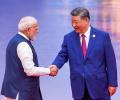
Ahead of Xi Jinping's visit, National Security Advisor Ajit Doval and Chinese Foreign Minister Wang Yi held extensive talks in Beijing on August 25 on the boundary issue and reached an eight-point consensus.

Indian benchmark equity indices, Sensex and Nifty, closed lower for the fourth consecutive session, driven by a surge in crude oil prices above USD 114 per barrel due to escalating tensions in West Asia, coupled with broad-based selling and FII outflows.
Despite not winning a medal at the recently-concluded Asian Senior Fencing Championships, India's men's foil team secured direct qualification for the upcoming Asian Games, marking a significant step forward for the sport in the country. The event, hosted in India for the first time, provided valuable experience and highlighted the growing competitiveness of Indian fencers against top Asian nations.
Faced with high energy costs hitting economies of the region, leaders of Association of South East Asian Nations and their dialogue partners on Monday agreed to strengthen regional cooperation on energy security

Saudi Arabia's East-West pipeline shutdown could make crude costlier for India as refiners face fewer supply routes and rising freight and insurance costs.

Bangladesh has confirmed that Prime Minister Tarique Rahman will not attend the upcoming BRICS Summit in India, clarifying that the invitation was extended to him as the BIMSTEC Chair, not as Bangladesh's Prime Minister. The nation is prioritising bilateral visits and discussions, while also addressing national interests like the expiring Ganges Water Sharing Treaty.

Indian benchmark indices Sensex and Nifty saw a rebound in early trade, driven by a moderation in crude oil prices, despite persistent selling by Foreign Institutional Investors (FIIs) and mixed global market cues.

Veteran Indian cricketers KL Rahul, Mohammed Siraj, and Devdutt Padikkal have been asked to play in the Duleep Trophy final for South Zone against East Zone. The participation of other T20I players like Tilak Varma, Vaibhav Sooryavanshi, and Ishan Kishan depends on Team India head coach Gautam Gambhir's approval. Additionally, chief selector Ajit Agarkar will attend the final, and the BCCI is arranging visas for net bowlers for the Asian Games.

Former US National Security Adviser John Bolton has stated that China is not prepared to back India's bid for a permanent seat on the UN Security Council. He highlighted that any expansion of permanent membership would require a UN Charter amendment, which China could veto. Bolton also discussed the broader institutional challenges facing the UN and suggested that regime change in Iran is crucial for long-term stability in West Asia, linking Houthi attacks to Iran's "ring of fire" strategy.

Japan is deepening its defence relationship with India while simultaneously expanding its economic, infrastructure and security engagement with countries around India -- particularly Bangladesh. The result is an emerging Japanese conception of South Asia in which India remains the strategic anchor, but the geography surrounding India is becoming increasingly important, points out Varun Arya.
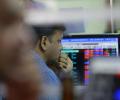
Indian benchmark equity indices, Sensex and Nifty, closed lower due to persistent geopolitical tensions in the Middle East and elevated crude oil prices, with investors remaining cautious ahead of fresh US sanctions on Iran.

Indian benchmark equity indices, Sensex and Nifty, opened higher on Monday, driven by strong buying in blue-chip stocks like HDFC Bank and Infosys, despite persistent geopolitical tensions and elevated crude oil prices.

Indian benchmark indices, Sensex and Nifty, experienced a sharp decline at the close of trade, with the Sensex dropping 539 points and the Nifty falling below 24,100, primarily due to selling pressure in HDFC Bank and ongoing geopolitical uncertainties.
Indian benchmark equity indices, Sensex and Nifty, rebounded in early trade, driven by a recovery in world markets due to easing US Treasury yields and fresh foreign fund inflows, halting a multi-day losing streak. Track Sensex, Nifty on August 20.

Indian stock markets, including the Sensex and Nifty, experienced a significant tumble in early trade, driven by escalating tensions in West Asia that pushed crude oil prices close to the USD 100-per-barrel mark, alongside selling in IT stocks and fresh foreign fund outflows.

Indian benchmark indices Sensex and Nifty experienced a significant slump in early trade, mirroring a bearish trend in global equities, as escalating conflict in West Asia drove up crude oil prices and intensified investor concerns.

Indian benchmark indices Sensex and Nifty experienced significant declines in early trade, driven by soaring crude oil prices amidst escalating tensions in West Asia, coupled with weak global market trends and foreign fund outflows.

China sailed through the crisis in the Strait of Hormuz relatively unscathed even as the impact of its steps shielded other consuming nations from having to pay high crude oil prices.

Prime Minister Narendra Modi addressed the Indonesian parliament, emphasising India's commitment to development over expansionism and advocating for a free, open, and inclusive Indo-Pacific. He highlighted the strong historical ties between India and Indonesia, calling for enhanced cooperation in various sectors, including defence, technology, and counter-terrorism, amidst growing concerns over regional security.

Indian benchmark indices, Sensex and Nifty, experienced significant declines, with the Sensex falling 493 points and the Nifty dropping for the sixth consecutive day, primarily due to elevated crude oil prices reaching USD 91 per barrel and diminishing hopes for a diplomatic resolution in West Asia.
The benchmark BSE Sensex rebounded by 362 points, ending a four-day losing streak, driven by strong buying in metal, private banking, and oil and gas shares, while the broader NSE Nifty saw modest gains despite paring some advances in the closing session.

Tata Steel plans to invest approximately Rs 20,000 crore in capital expenditure during the current financial year (FY27), a significant increase from the previous year, with 60 per cent of this allocation directed towards its India business for expansion, new technologies, and sustainability.

'I'm talking about God, not some character in a film. That was the challenge that I had to bring out in Ranbir Kapoor's character. The costume was not important, what was important was a visual effect, where you look at him, there should be a certain kind of warmth in your heart.'

Indian benchmark indices closed mixed, with the Sensex gaining 113.61 points to 78,079.96 and the Nifty falling 40.10 points to 24,395.85, as elevated crude prices and ongoing geopolitical uncertainty in the Middle East made investors cautious.
